By: Zoe Glover
Zoo Educator
International Tiger Day, which takes place annually on July 29th, is a day that was founded in 2010 with the goal to double the number of wild tigers by 2022 [1]. As of 2010, there were 3,200 wild tigers, but the number has not doubled, as there are 3,500 as of 2023. There are two distinct species with several subspecies [2, 3]. They are as follows:
Sunda island tiger (Panthera tigris sondaica)- live or lived on Indonesian islands [7]
- Bali tiger (extinct)
- Javan tiger (extinct)
- Sumatran
- Smallest subspecies
Continental (Panthera tigris tigris)- live or lived in mainland Asia [7]
Bengal tiger
Malayan tiger
Indochinese tiger
Caspian tiger (extinct)
South China tiger (functionally extinct)
Amur tiger (formally known as the Siberian tiger)
- Largest subspecies
- We have 16-year-old Changbai here at the zoo, who is part of the Species Survival Plan (SSP), a breeding program which encourages population health and stability.
- Changbai recently became a grandmother, as her daughter, Zeya, who is located at the Rosamond Gifford Zoo in New York, just had cubs!
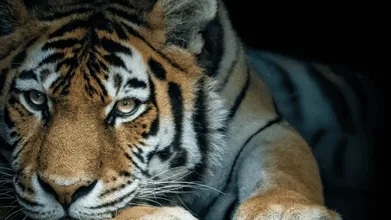
No two sets of tiger stripes are the same, as they are the equivalent to a human fingerprint: unique to everyone. Additionally, their stripes play an important role in their hunting, as they provide some form of camouflage [4, 5].
Tigers are amazing hunters, as they use sight and sound as opposed to sound for hunting and stalking prey at night [4]. They can eat up to 80 pounds of meat about once a week, which include wild boar and deer, monkeys, buffalo, sloth bears, leopards, and crocodiles [4, 5].
Many people walk by the tiger habitat and may think Changbai is lonely, but she is not, as tigers are known to be solitary creatures, except for mating and raising young [5]. They will remain solitary for their 10 to 15 years of life out in the wild and will usually have cubs at 3 to 4 years of age between November and April [5].
These large cats experience a wide variety of threats, including poaching, loss of prey, and habitat fragmentation and loss for human development. With tiger populations scattered in thirteen countries, it is estimated that there are 3,500 individuals left in the wild, decreasing from an estimated 100,000 individuals [4]. Tigers are recognized as a CITES species, meaning they are recognized under the Convention on International Trade in Endangered Species of wild fauna and flora document, which maintains the survival of species that are internationally traded [6].
As a reader there are many things you can do to save this apex predator. You can:
- Visit zoos
- Donate to zoos and conservation programs
- Support conservation programs
[1]- https://tigers.panda.org/news_and_stories/stories/the_world_celebrates_world_tiger_day/
[2]- https://www.science.org/content/article/controversial-study-claims-there-are-only-two-types-tiger
[3]- https://www.worldwildlife.org/species/tiger
[4]- https://nc.iucnredlist.org/redlist/amazing-species/panthera-tigris/pdfs/original/panthera-tigris.pdf
[6]- https://cites.org/eng/disc/what.php
[7]- https://a-z-animals.com/blog/the-types-of-tiger-species-from-around-the-world/