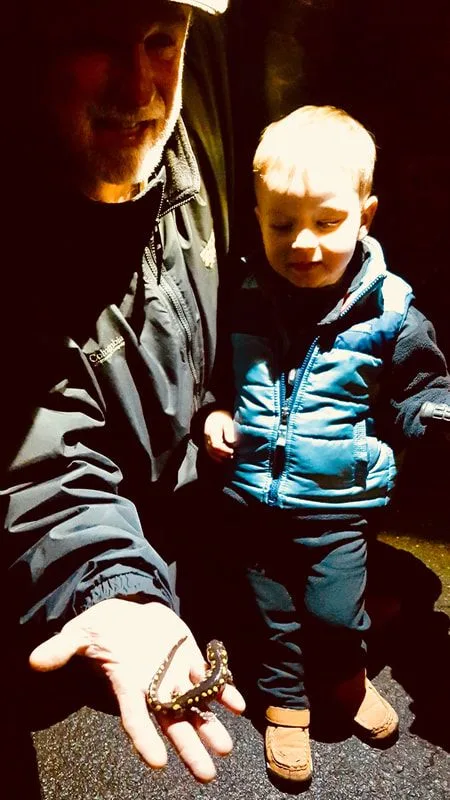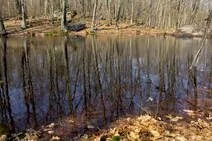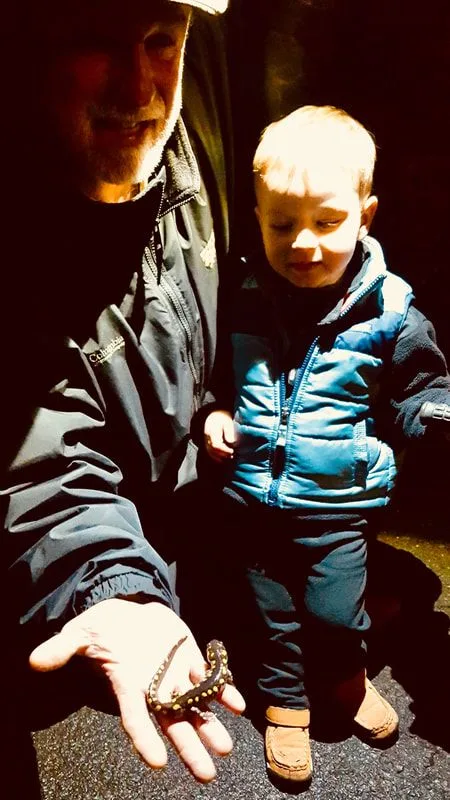
While many of us are looking up and out, watching for trees and flowers to burst into bloom, Zoo Director Gregg Dancho is looking down. His gaze is on the here today-gone tomorrow vernal pools.
Also known as ephemeral pools, vernal pools appear in woodlands for a brief period each spring. Formed during the fall and winter by snow and rain pooling in shallow depressions, by summer they’re gone. While they’re here in spring, however, they offer a critical nursery for many species: tree peepers, wood frogs, and fairy shrimp, among others.
When the weather is about fifty degrees at night and a light rain is falling, the spring migration begins. It’s a march of amphibians, from uplands to lowlands. A steady procession starts with spotted salamanders when ice still covers the pools’ surfaces, but then extends to red back salamanders, wood frogs and others. These are obligate vernal pool species, “obligated” to use a vernal pool for a part of their life cycle.

Because vernal pools are often dry by summer, people commonly fail to recognize their importance in sustaining native species. Without being educated about their place in the life cycle, well-meaning people may clear and build on the land, removing critical support for biodiversity. These seasonal wetlands perform important ecological functions even though small and always temporary.
Knowledge leads to understanding, and then progresses to compassion and protection. Look for vernal pools on your walks and hikes through woodlands, or on your own property if shallow pools form there. Signs of life are all around us, but sometimes we have to look closely to see it. There’s a music to spring life, as well, in the songs of migrating birds and tree frogs, reminding us that protecting nature must be second nature for all of us.
“So many voices, so many languages, beyond human tongues, are never listened to.”
-David M. Carroll
How Can You Help?
Frogs and amphibians are our new canaries in the coal mine. Their skin is very porous, and so they quickly reflect damage from contaminants in their environment. Also known as a “sentinel” species, their aquatic homes are affected by chemical runoff from lawn and garden fertilizers and biocides even miles away.
The Zoo participates in FrogWatch USA, and you can, too. FrogWatch USA is a citizen science program that provides individuals, groups, and families opportunities to learn about wetlands in their communities by reporting on the calls of local frogs and toads. In a collaboration between the Zoo, The Maritime Aquarium, and Yale’s Peabody Museum of Natural History, volunteers make regular visits to wetlands in your neighborhoods and keep a frog log to record the frog and toad calls you hear. Working with experts, volunteers will learn about local frog species, then visit wetlands once or twice a week for about 15 minutes each night this spring and summer.
The watch begins a half hour after sunset, making the watch ideal for families with older children. Observations are reported to a national online database to contribute to amphibian conservation efforts. More information here:
https://www.beardsleyzoo.org/frogwatch.html
The last training takes place on March 25th at 7 p.m.
“When one tugs at a single thing in nature, he finds it attached to the rest of the world.”
–John Muir