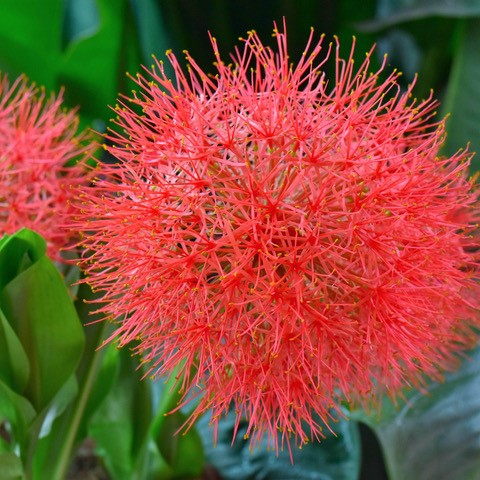
(Scadoxus multiflorus)
Blood Lily
The Blood Lily (Scadoxus multiflorus) is a visually stunning plant known for its dramatic, globe-shaped blooms and adaptability. Classified as both a perennial and an evergreen, it can grow from bulbs or rhizomes—making it a versatile and resilient species.
Its large, smooth green leaves remain vibrant year-round, while its signature flower head emerges on a single upright stem. Each plant produces just one bloom per season, forming a spherical cluster of nearly 200 tiny flowers in vivid shades of red and pinkish-orange. These intricate blooms feature protruding stamens with bright yellow anthers, creating a firework-like display that can reach up to 10 inches in diameter. Though short-lived—lasting about two weeks—the flower is unforgettable.
It’s important to note that the Blood Lily contains naturally occurring compounds such as lycorine, which can be toxic if ingested. Historically, these properties have been used in traditional practices, such as medicine and hunting tools.
Habitat
Blood Lilies are native to sub-Saharan and tropical regions of Africa, as well as parts of the Arabian Peninsula. They thrive in a wide range of environments, including lowland and mountain forests, savannah woodlands, and open grasslands. They are most commonly found in shaded areas, particularly along riverbanks.
Family Life
Blood Lilies reproduce through both bulb division and seed sowing. Bulb division occurs when the main bulb produces smaller offshoots that can be separated and replanted. Seeds develop after flowering and can be sown in nutrient-rich soil, though it may take up to five years for new plants to bloom.
Flowering typically occurs from late summer to early autumn. After blooming, the plant produces green berries that ripen to a bright scarlet during winter and spring. These decorative berries can remain on the plant for up to two months.
Life Span
The lifespan of a Blood Lily can vary significantly depending on its environment and growing conditions.
Status
Blood Lilies are currently classified as “Least Concern.” However, like many plant species, they are impacted by environmental changes, including global climate change.