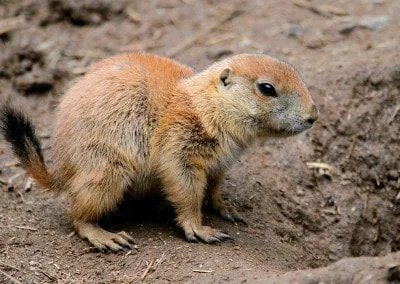
(Cynomys ludovicianus)
Black-tailed Prairie Dog
Physical Description
Black-Tailed Prairie Dogs are sturdy rodents that grow about 14 to 17 inches long and typically weigh between 2 and 3 pounds.
They have broad, rounded heads, short legs, small ears, large dark eyes, and hairy tails with a distinctive black tip. Their fur is usually brown, with darker ears and a pale buff or whitish underside.
Where They Live
Black-Tailed Prairie Dogs live in short- and mid-grass prairies and on open plateaus.
They are native to central North America, ranging from Texas north to the Canadian border.
They spend much of their lives underground in large burrow systems that can include separate spaces for sleeping, nesting, eating, and even bathroom areas.
What They Eat
Black-Tailed Prairie Dogs are primarily herbivores, feeding on grasses, roots, weeds, herbs, and blossoms.
They will occasionally eat insects, and they get all the water they need from the food they eat.
Life & Family
Black-Tailed Prairie Dogs are highly social and live in close-knit family groups made up of one male, several related females, and their young.
Mating usually takes place in late January, and pups are typically born in March or April. Females usually have one litter a year, often with 3 to 5 pups, though litters can be larger.
Young prairie dogs are born blind and hairless. Their eyes open after about a month, and by around 6 weeks old, they begin appearing above ground and start becoming more independent.
Black-Tailed Prairie Dogs usually live 4 to 8 years in the wild and up to 10 years in human care.
Behavior
Black-Tailed Prairie Dogs are known for their warning calls. When one spots danger, it gives a sharp bark and quickly disappears into its burrow. Others nearby watch and repeat the call if the threat gets closer.
They are also mostly crepuscular, meaning they are most active in the early morning and evening, especially during warmer months.
Status
Least Concern