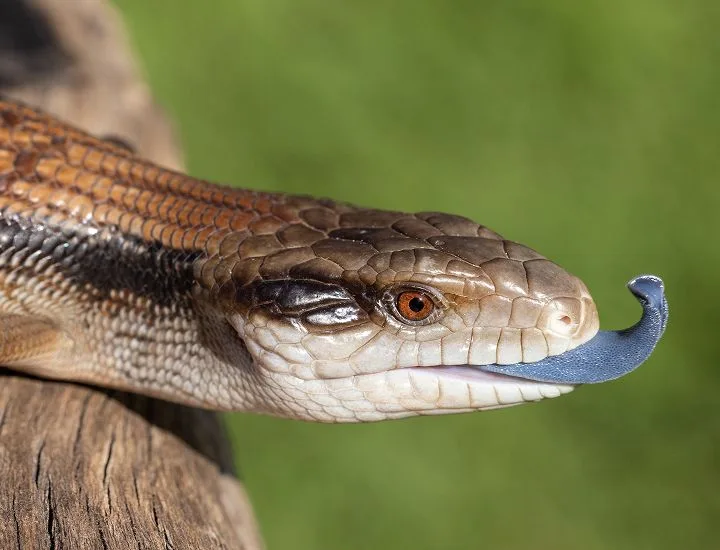
(Tiliqua scincoides)
Blue-tongued Skink
Physical Description
The Blue-Tongued Skink has a sturdy body, short legs, and an unusually large head. Adults typically grow to about 1.5 to 2 feet long and weigh around one pound. Their smooth overlapping scales range in color from light brown to silvery gray, often with darker bands across the body and tail. Their most recognizable feature is their large blue tongue, which flashes inside a bright pink mouth. Blue-Tongued Skinks also have transparent eyelids that help protect their eyes from dirt and bright sunlight. Like all reptiles, they are ectothermic, meaning they rely on outside heat sources like the sun to regulate body temperature.
Where They Live
Blue-Tongued Skinks prefer open grasslands and other sunny areas with plenty of shelter, such as leaf litter, rocks, and fallen logs. They are found in eastern and central Australia, mostly outside of the continent’s dry interior.
What They Eat
Blue-Tongued Skinks are omnivores, feeding on a mix of plants, insects, snails, worms, and other small invertebrates.
Life & Family
Blue-Tongued Skinks usually live alone outside of breeding season and are known to be highly territorial. Unlike many reptiles, females give birth to live young rather than laying eggs. A mother may have 15 to 25 babies at a time, but the young only stay with her until after their first shed. After that, they begin living independently and typically reach maturity at around 3 years old. They usually live about 15 to 18 years in the wild and around 20 years in human care.
Senses & Survival
Blue-Tongued Skinks rely heavily on their sense of smell to understand their environment. They do this by flicking their tongues to collect tiny chemical particles from the air. That tongue flicking can happen as many as 300 times per hour, helping them detect food, predators, and changes in their surroundings.
Status
Least Concern