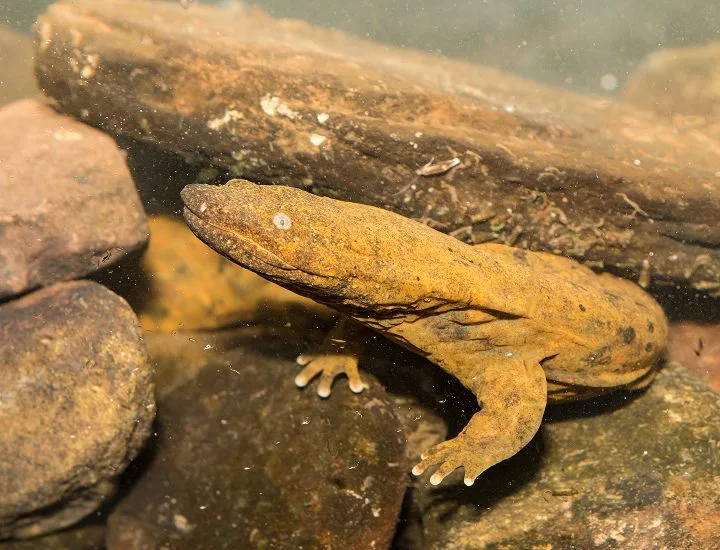
(Cryptobranchus alleganiensis alleganiensis)
Eastern Hellbender
Physical Description
The Eastern Hellbender is the largest aquatic amphibian in the United States. It has a flattened head and body, small eyes, short sturdy legs, and a long tail that helps it move through fast-moving water. Eastern Hellbenders can grow up to 29 inches long and usually weigh between 4 and 6.5 pounds. Their coloring ranges from grayish brown to olive brown or nearly black, often with darker mottled markings across the back and sides. They also have loose skin folds along their bodies that help them absorb oxygen directly from the water.
Where They Live
Eastern Hellbenders live in clean, cold, fast-flowing freshwater streams with low pollution and low sediment. They spend much of their time hiding under large rocks and submerged cover, where they shelter in dens and stay protected during the day. Their range stretches across parts of the eastern United States, from southern New York to northeastern Mississippi, and west to southern Illinois.
What They Eat
Eastern Hellbenders are carnivores and mostly feed on crayfish. They may also eat fish, worms, frogs, small snakes, and other aquatic invertebrates.
Life & Family
Eastern Hellbenders are mostly solitary and are active year-round, especially at night. Males dig out nesting spaces under rocks to attract females. After eggs are laid, the male guards the nest until the eggs hatch, which usually takes about 70 days. Young Hellbenders begin life with external gills, but as they grow, those gills disappear and they begin breathing entirely through their skin. Eastern Hellbenders can live around 30 years in the wild and up to 50 years in human care.
Freshwater Indicator Species
Because Eastern Hellbenders breathe through their skin, they are especially sensitive to water quality. That makes them an important indicator species. When Hellbenders are present in a stream, it often means that waterway is still healthy enough to support a wide range of aquatic life.
Status
Vulnerable