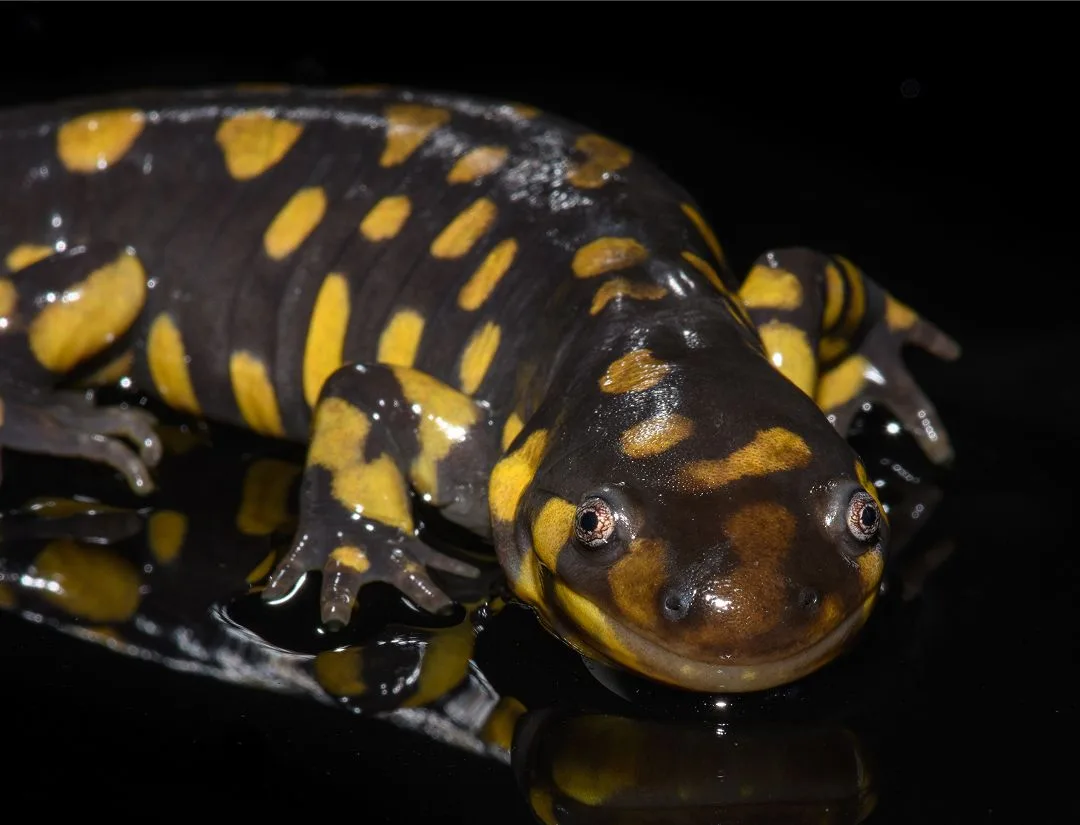
(Ambystoma tigrinum)
Eastern Tiger Salamander
Physical Description
Eastern Tiger Salamanders have thick, dark bodies marked with yellow, tan, or olive spots and stripes. Their underside is usually lighter in color, ranging from yellowish to olive tones. They grow to about 7 to 13 inches long and have a broad head, rounded snout, and smooth, moist skin suited for both underground and surface environments. Males are typically longer than females and have slightly more developed hind legs and tails.
Where They Live
Eastern Tiger Salamanders live in forests, grasslands, and marshes, always close to permanent water sources. They are found across much of North America, from Canada through the United States and into Mexico. For most of the year, they live underground, burrowing into moist soil to stay protected from temperature changes and drying out.
What They Eat
Eastern Tiger Salamanders are carnivores. Adults eat worms, insects, snails, and slugs, while younger salamanders feed on small aquatic organisms, including crustaceans and insect larvae. As they grow, they may begin eating tadpoles, small fish, and other amphibians.
Life & Family
Eastern Tiger Salamanders reproduce in small pools of water, where females lay egg masses attached to vegetation or debris. Each female can lay hundreds of eggs, and the larvae hatch within a few weeks. Young salamanders live in the water until they develop into adults, though some may remain in their aquatic form for life, a condition known as paedomorphy. They can live up to about 16 years in the wild and up to 25 years in human care.
Underground Life
Eastern Tiger Salamanders spend much of their lives beneath the surface, often burrowing more than two feet underground. This behavior helps them avoid extreme temperatures and dry conditions, allowing them to thrive in a wide range of habitats. Because of this, they are sometimes called Mole Salamanders.
Status
Least Concern