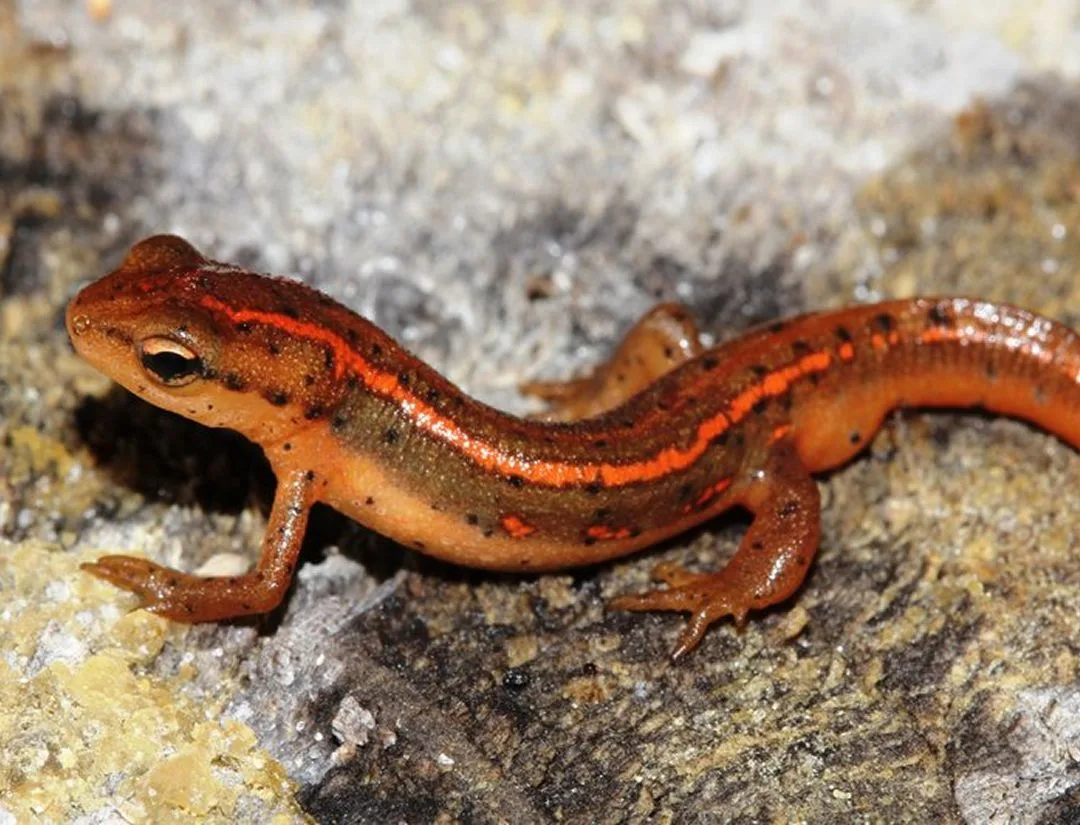
(Notophthalmus perstriatus)
Striped Newt
Physical Description
Striped newts grow to about 4 inches long as adults and are typically olive green to brown in color. Their undersides are yellow to tan with black speckling. As juveniles, called efts, they are much brighter in color and often appear orange, which helps warn predators that they may be toxic. In their aquatic larval stage, striped newts also have visible external gills that help them breathe underwater.
Where They Live
Striped newts have a biphasic, or two-stage, life cycle that takes them through both aquatic and terrestrial habitats. They begin life in wetlands as aquatic larvae before undergoing metamorphosis and moving onto land. On land, they are often found in dry upland habitats such as sandhills, flatwoods, and scrub environments. They are especially associated with fire-maintained habitats, and prescribed burns play an important role in preserving the open landscapes they depend on.
What They Eat
Striped newts eat a variety of small insects and plant material.
Life & Family
Striped newts are generally solitary except during breeding season. Their life cycle is especially unusual and can follow more than one path. Some individuals develop into terrestrial juveniles, or efts, before later becoming adults. Others may remain aquatic in a form known as a paedomorph, meaning they keep certain larval traits, such as gills, even after becoming reproductively mature. As ponds dry or environmental conditions change, these aquatic individuals may continue developing into fully terrestrial adults. In the wild, striped newts typically live 12 to 15 years, and they can live up to 17 years in human care.
More Than One Path to Adulthood
One of the most fascinating things about the Striped Newt is its flexible life cycle. Depending on environmental conditions, individuals may develop in different ways before reaching adulthood. Their bright orange eft stage also serves as a warning to predators, helping protect them while they live on land. This combination of adaptability and defense makes the striped newt a particularly unique amphibian species.
Status
Near Threatened